

162 cm
Avg annual snowfall
56
Snow days a year
24 hr
Bylaw clearing window
$1,000
Bylaw fine for lot snow on the road
Commercial snow and ice management in Gateway
Gateway is the west-central retail node built around the power centre near 111 Street, with big-box, quick-service restaurants, fitness and service tenants spread across pad sites and shared drive aisles between roughly 103 and 108 Avenue.
The defining problem here is not snow volume. It is boundaries. Pad-site retail is carved into separately owned or separately leased parcels stitched together by shared access roads, and the reciprocal easement agreement that says who clears which strip is usually a document nobody has read since it was signed.
The result every winter is the same: the pads get cleared, the connectors between them do not, and the first slip-and-fall claim lands on whichever tenant is closest. A Gateway contract has to start with a site map that assigns every square metre to somebody.
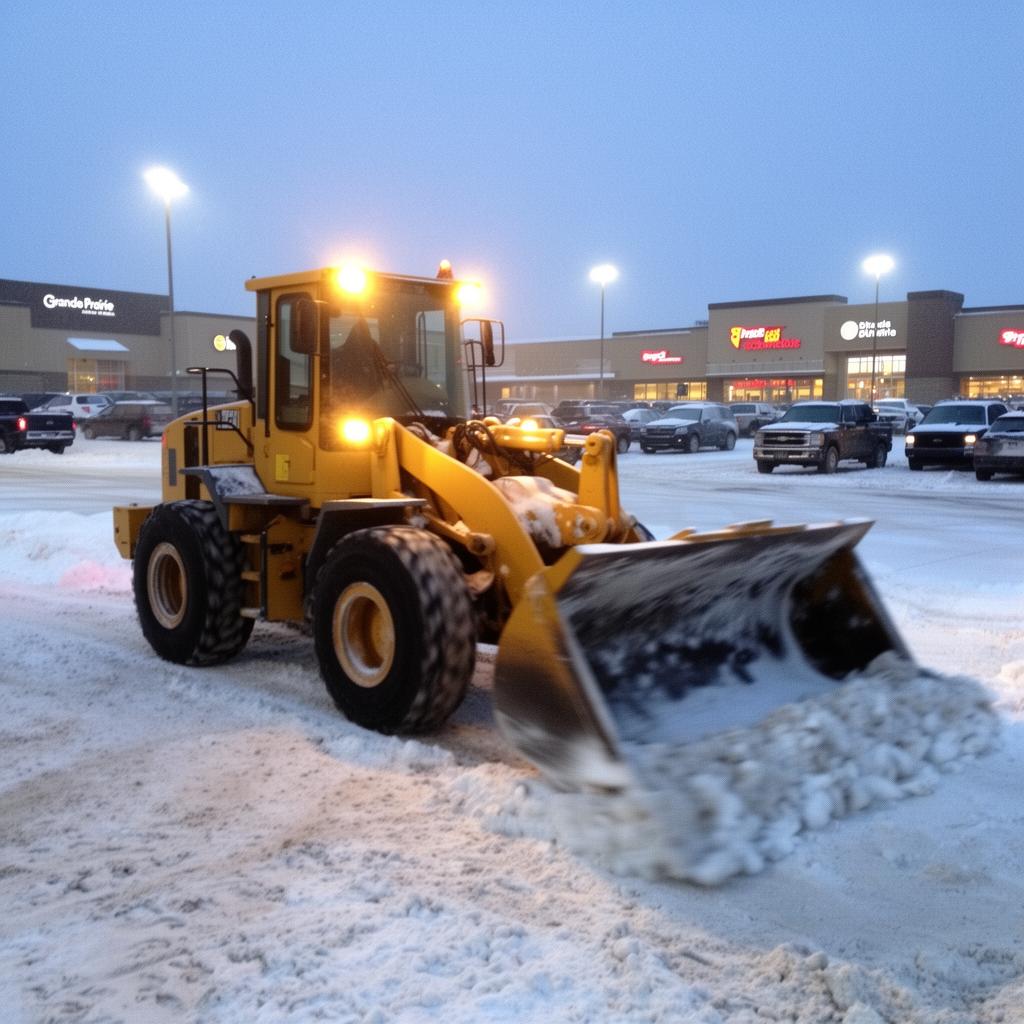
Property types we service in Gateway
Roads and access
- 100 Avenue and 103 Avenue
- 104 Avenue and 108 Avenue — 108 Avenue is a City Priority 1 route
- 108 Street, 110 Street and 111 Street
- 116 Street connection to the Westgate cluster
The pad-site problem, and the drive-thru clock
- Shared access roads between pads are the gap. If the contract does not name them, they do not get cleared, and the liability lands on whoever is nearest.
- Drive-thru lanes have to be open and sanded before the first coffee rush, which in practice means finished by 5:30 or 6 a.m., not 8.
- A drive-thru lane is a narrow curbed channel. It ices faster than the open lot and it cannot be cleared with a full-width pass.
- Pedestrian crossings between pads carry foot traffic across drive aisles in the dark at both ends of the day — they need traction material, not just a scrape.
- Pad sites bill separately, so a single site walk and a single map that assigns every strip prevents both double-billing and gaps.
- Curb stops, bollards, patio rails and menu boards are the standard casualties. They get staked before the first snowfall.
The Grande Prairie bylaw that costs commercial owners money
Under City of Grande Prairie Traffic Bylaw C-1166 s.37.1A, placing snow or ice removed from a commercial or industrial property onto a highway or other public property carries a $1,000 fine — ten times the $100 penalty that applies to a residential property under s.37.1. Section 37.3 then requires the snow to be removed within 24 hours, and s.37.4–37.5 let the City remove it and bill the full cost back to whoever put it there.
Separately, s.38.1 requires the occupant or owner of a property adjacent to a sidewalk to clear snow and ice from that sidewalk within 24 hours following the most recent deposit of snow or ice. Read that wording carefully: the clock runs from the most recent deposit, not from the end of the storm. In a multi-day event it restarts. If the walk is not cleared, s.38.4 lets the City clear it and add the cost to the property's tax roll.
A cheap operator who blades your lot into the street is not saving you money. They are exposing you to a $1,000 ticket, a cleanup order, and a City invoice.
One distinction worth making, because it trips people up: the City now clears the windrows it leaves across residential driveway entrances during residential plowing, and says so on its own snow clearing page. That commitment is about driveways on residential routes. It does not cover commercial approaches on Priority 1 and Priority 2 arterials, which are cleared to a different standard and on a different schedule. If your entrance is on an arterial, the plow line across it is still yours to move.
Read the full breakdown of the 24-hour rule
City of Grande Prairie Traffic Bylaw C-1166, office consolidation as amended through C-1166J, effective 21 August 2023, ss. 37 and 38 and Schedule 1.
Where the snow goes in Gateway
Pad-site lots have less room than they look like they have once you exclude the drive aisles and the fire routes. Pile locations get agreed with the landlord or the easement administrator before the season, not negotiated in a snowstorm.
Pushing pad snow out onto 108 Avenue, 108 Street or any other public road is a $1,000 offence for a commercial property under C-1166 s.37.1A, plus a 24-hour removal order and a City invoice if it is not cleaned up.
Where the pads genuinely have no room, hauling to privately arranged land is scheduled mid-season. There is no public commercial snow dump in Grande Prairie.
How a PWW commercial snow contract works
What every commercial snow contract with us includes, Gateway included.
Written trigger depth
Service starts at an accumulation depth agreed in the contract, not when somebody decides it looks bad enough. You know exactly what buys you a visit.
Named response window
A finish time tied to your operation — before dayshift, before open, before the morning rush — rather than a vague same-day promise.
In-storm service
On contract sites we work during the event at the trigger depth instead of waiting for it to end. Snow left to pack under traffic becomes ice you have to chip off.
Separate ice-management cycle
Sanding and de-icing run on their own schedule, not bundled into the plow pass. The City applies ice control on priority routes from October 15 to April 15; your site needs the same continuity.
Documented service log
Date, time, conditions, areas cleared and material applied, recorded every visit. A slip-and-fall claim can arrive more than a year later and the log is what answers it.
Pre-season site walk
Curb stops, bollards, irrigation heads, cart corrals, fire routes and pile locations all mapped and staked before the first snowfall, so nothing gets found by a blade in the dark.
Related services for Gateway properties
Frequently asked questions — commercial snow removal in Gateway
Who is supposed to clear the shared access road between the pads?
Whoever the reciprocal easement agreement says, which is usually the landlord or a cost-shared arrangement across the pads. In practice it is the strip that gets missed. We map it at quoting and put it in writing in the contract so it is covered rather than assumed.
Can you have a drive-thru open by opening?
Yes. Drive-thru lanes are sequenced first on the site, cleared as a narrow channel rather than a full-width pass, and sanded, so the lane is open before the morning rush rather than during it.
We are one tenant in the plaza, not the landlord. Can we still hire you?
Yes. We regularly hold a contract for a single pad or a single tenancy. We will map what is yours under the lease and quote only that, and we will tell you plainly which adjoining strips are not covered so you can raise it with the landlord.
How do you avoid taking out our curb stops and patio rails?
Site walk before the season, everything fragile staked and marked, and the same operators on the same sites so the crew knows where things are under 30 cm of snow.